Buy miragespa.eu ?
We are moving the project
miragespa.eu .
Are you interested in purchasing the domain
miragespa.eu ?
domain@kv-gmbh.de · 0541-91531010
Buy miragespa.eu ?
Will archaeologists?
Will archaeologists continue to uncover new discoveries and expand our understanding of ancient civilizations? Yes, archaeologists will likely continue to make new discoveries as technology advances and more sites are explored. By studying these findings, archaeologists can provide valuable insights into the past and help us piece together the puzzle of human history. Their work is crucial in preserving and interpreting our cultural heritage for future generations. **
What tools do archaeologists use?
Archaeologists use a variety of tools to excavate, analyze, and interpret artifacts and sites. Some common tools include trowels for digging, brushes for delicate cleaning, sieves for sifting through soil, and measuring tapes for mapping out the site. They also use technology such as ground-penetrating radar, 3D scanners, and drones to aid in their research and documentation. Additionally, archaeologists may use laboratory equipment like microscopes, X-ray machines, and carbon dating techniques to analyze and date artifacts. **

Similar search terms for Archaeologists
Top-Angebote
Products related to Archaeologists:
-
Dove Purely Pampering Shea Butter & Vanilla setDove Purely Pampering Shea Butter & Vanilla, 1 pc, Cosmetic Sets for Women, Discover a practical bundle of products designed to enhance your everyday moments. DovePurely PamperingShea Butter & Vanilla set takes the hassle out of choosing by offering a combination of popular products. Now available together in one convenient pack. The set contains: Dove Purely Pampering Shea Butter & Vanilla creamy tablet for washing 3x90.00 g Characteristics: cleans skin deeply cleans the skin gently do not irritate or dry out skin nourishes and hydrates protects the skin soothes irritation gives a rich lather Ingredients: shea butter – nourishes, helps retain necessary hydration in skin, adds softness and smoothness, provides protection against drying and harmful external influences How to use: Follow the instructions on the package. Apply the soap to the skin, lather gently, and massage. Rinse with lukewarm water. Apply at any time during the day.4,30 £*Shipping: 3,99 £Secure redirect to the provider
-
Nourison Tranquility Area RugDiscover a special feeling of serene elegance in this uniquely refined collection of contemporary area rugs. In subtly varied palettes of soft color and muted neutrals, these distinctive designs will grace any room with a note of quiet sophistication.449,00 $*Shipping: 0,00 $Secure redirect to the provider
-
Nourison Tranquility Area RugDiscover a special feeling of serene elegance in this uniquely refined collection of contemporary area rugs. In subtly varied palettes of soft color and muted neutrals, these distinctive designs will grace any room with a note of quiet sophistication.949,00 $*Shipping: 0,00 $Secure redirect to the provider
-
Nourison Tranquility Area RugDiscover a special feeling of serene elegance in this uniquely refined collection of contemporary area rugs. In subtly varied palettes of soft color and muted neutrals, these distinctive designs will grace any room with a note of quiet sophistication.1329,00 $*Shipping: 0,00 $Secure redirect to the provider


-
Which tools do archaeologists use?
Archaeologists use a variety of tools to excavate, analyze, and interpret artifacts and sites. Some common tools include trowels for digging, brushes for delicate cleaning, measuring tapes and levels for mapping, and sifters for sorting through soil. They also use technology such as ground-penetrating radar, drones, and 3D scanners to aid in their research and documentation. Additionally, laboratory equipment like microscopes, X-ray machines, and carbon dating techniques are used to analyze and date artifacts. **
-
Do archaeologists count as historians?
Archaeologists and historians both study the past, but they do so in different ways. Historians primarily rely on written records and documents to understand and interpret historical events, while archaeologists study material remains such as artifacts, structures, and human remains to reconstruct and understand past societies. While archaeologists do contribute to our understanding of history, they are not typically considered historians in the traditional sense. However, their work often complements and enriches the historical record, providing valuable insights into the lives and cultures of past societies. **
-
What specialization do archaeologists specialize in?
Archaeologists specialize in the study of human history and prehistory through the excavation and analysis of artifacts, structures, and other physical remains. They may focus on specific time periods, regions, or cultures, such as ancient Egypt, the Roman Empire, or pre-Columbian America. Some archaeologists also specialize in specific methods of analysis, such as DNA testing or remote sensing technology. Overall, archaeologists work to uncover and interpret the material culture of past societies in order to understand human behavior and development over time. **
-
From when are grave robbers considered archaeologists?
Grave robbers are considered archaeologists when they follow ethical guidelines and scientific methods in their excavation of burial sites. This includes obtaining proper permits, documenting their findings, and preserving artifacts for study and public education. Archaeologists are trained professionals who work within legal and ethical frameworks to uncover and interpret the past, while grave robbers engage in illegal and destructive activities for personal gain. The distinction between the two lies in their approach to excavation and their commitment to preserving cultural heritage. **


How many languages do archaeologists typically learn?
Archaeologists typically learn multiple languages in order to conduct their research effectively. The exact number of languages can vary depending on the region and time period they are studying, but it is common for archaeologists to be proficient in at least two or three languages relevant to their area of focus. This may include ancient languages, modern languages spoken in the region, and academic languages used in the field of archaeology. Overall, the ability to understand and communicate in multiple languages is an important skill for archaeologists to have in order to access and interpret a wide range of sources and materials. **
What are the job prospects for archaeologists like?
Job prospects for archaeologists can vary depending on factors such as location, experience, and specialization. Overall, the job market for archaeologists is competitive, with a limited number of positions available in academia, government agencies, museums, and cultural resource management firms. Those with advanced degrees and field experience may have better job prospects, especially in areas with high demand for archaeological research and preservation. Networking, gaining practical skills, and staying current with developments in the field can also improve job opportunities for archaeologists. **
Top-Angebote
Products related to Archaeologists:
-
I Love Wellness Calm bath salt for relaxation 500 gI Love Wellness Calm, 500 g, Bath Salts for Women, Do you love long baths in nice hot water? Your favourite relaxation ritual can be enhanced and taken to another level by I Love Wellness Calmbath salts. It lets you create a fragrant salt bath right in your own home, allowing tension and feelings of inner turmoil to melt away while creating a wonderful sense of well-being. But you don't just get the relaxation you deserve, although the intoxicating smell of salt certainly invites you to do so. Apart from relaxation, your body will also be treated to regeneration. Salt is rich in natural minerals, so it will help with skin regeneration and contribute to relieving any skin issues you may have. Characteristics: relaxing effect has a pleasant fragrance moisturises and softens strengthens the skin’s defences has a relaxing effect on the muscles of the body Ingredients: vegan product camomile extract – soothes, counteracts irritation, helps reduce redness and promotes regeneration How to use: Pour into a warm bath and allow to dissolve.4,68 £*Shipping: 3,99 £Secure redirect to the provider
-
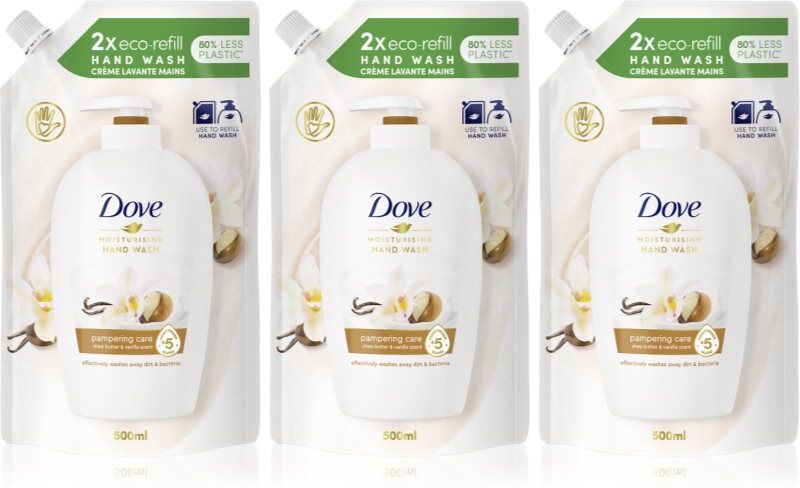
Dove Moisturizing Hand Wash Pampering Care setDove Moisturizing Hand Wash Pampering Care, 1 pc, Refills for Women, Discover a practical bundle of products designed to enhance your everyday moments. DoveMoisturizing Hand WashPampering Care set takes the hassle out of choosing by offering a combination of popular products. Now available together in one convenient pack. The set contains: Dove Purely Pampering Shea Butter & Vanilla liquid soap refill 3x500.00 ml Characteristics: a set at a favourable price has a pleasant fragrance leaves a refreshing feeling has softening effects nature-friendly packaging Ingredients: shea butter – nourishes, helps retain necessary hydration in skin, adds softness and smoothness, provides protection against drying and harmful external influences How to use: Follow the instructions on the package.6,90 £*Shipping: 3,99 £Secure redirect to the provider
-
Dove Purely Pampering Shea Butter & Vanilla setDove Purely Pampering Shea Butter & Vanilla, 1 pc, Cosmetic Sets for Women, Discover a practical bundle of products designed to enhance your everyday moments. DovePurely PamperingShea Butter & Vanilla set takes the hassle out of choosing by offering a combination of popular products. Now available together in one convenient pack. The set contains: Dove Purely Pampering Shea Butter & Vanilla creamy tablet for washing 3x90.00 g Characteristics: cleans skin deeply cleans the skin gently do not irritate or dry out skin nourishes and hydrates protects the skin soothes irritation gives a rich lather Ingredients: shea butter – nourishes, helps retain necessary hydration in skin, adds softness and smoothness, provides protection against drying and harmful external influences How to use: Follow the instructions on the package. Apply the soap to the skin, lather gently, and massage. Rinse with lukewarm water. Apply at any time during the day.4,30 £*Shipping: 3,99 £Secure redirect to the provider
-
Nourison Tranquility Area RugDiscover a special feeling of serene elegance in this uniquely refined collection of contemporary area rugs. In subtly varied palettes of soft color and muted neutrals, these distinctive designs will grace any room with a note of quiet sophistication.449,00 $*Shipping: 0,00 $Secure redirect to the provider
-
Will archaeologists?
Will archaeologists continue to uncover new discoveries and expand our understanding of ancient civilizations? Yes, archaeologists will likely continue to make new discoveries as technology advances and more sites are explored. By studying these findings, archaeologists can provide valuable insights into the past and help us piece together the puzzle of human history. Their work is crucial in preserving and interpreting our cultural heritage for future generations. **
-
What tools do archaeologists use?
Archaeologists use a variety of tools to excavate, analyze, and interpret artifacts and sites. Some common tools include trowels for digging, brushes for delicate cleaning, sieves for sifting through soil, and measuring tapes for mapping out the site. They also use technology such as ground-penetrating radar, 3D scanners, and drones to aid in their research and documentation. Additionally, archaeologists may use laboratory equipment like microscopes, X-ray machines, and carbon dating techniques to analyze and date artifacts. **
-
Which tools do archaeologists use?
Archaeologists use a variety of tools to excavate, analyze, and interpret artifacts and sites. Some common tools include trowels for digging, brushes for delicate cleaning, measuring tapes and levels for mapping, and sifters for sorting through soil. They also use technology such as ground-penetrating radar, drones, and 3D scanners to aid in their research and documentation. Additionally, laboratory equipment like microscopes, X-ray machines, and carbon dating techniques are used to analyze and date artifacts. **
-
Do archaeologists count as historians?
Archaeologists and historians both study the past, but they do so in different ways. Historians primarily rely on written records and documents to understand and interpret historical events, while archaeologists study material remains such as artifacts, structures, and human remains to reconstruct and understand past societies. While archaeologists do contribute to our understanding of history, they are not typically considered historians in the traditional sense. However, their work often complements and enriches the historical record, providing valuable insights into the lives and cultures of past societies. **
Similar search terms for Archaeologists
-
Nourison Tranquility Area RugDiscover a special feeling of serene elegance in this uniquely refined collection of contemporary area rugs. In subtly varied palettes of soft color and muted neutrals, these distinctive designs will grace any room with a note of quiet sophistication.949,00 $*Shipping: 0,00 $Secure redirect to the provider
-
Nourison Tranquility Area RugDiscover a special feeling of serene elegance in this uniquely refined collection of contemporary area rugs. In subtly varied palettes of soft color and muted neutrals, these distinctive designs will grace any room with a note of quiet sophistication.1329,00 $*Shipping: 0,00 $Secure redirect to the provider
-
Nourison Tranquility Area RugDiscover a special feeling of serene elegance in this uniquely refined collection of contemporary area rugs. In subtly varied palettes of soft color and muted neutrals, these distinctive designs will grace any room with a note of quiet sophistication.449,00 $*Shipping: 0,00 $Secure redirect to the provider
-
Nourison Tranquility Area RugDiscover a special feeling of serene elegance in this uniquely refined collection of contemporary area rugs. In subtly varied palettes of soft color and muted neutrals, these distinctive designs will grace any room with a note of quiet sophistication.199,00 $*Shipping: 0,00 $Secure redirect to the provider
-
What specialization do archaeologists specialize in?
Archaeologists specialize in the study of human history and prehistory through the excavation and analysis of artifacts, structures, and other physical remains. They may focus on specific time periods, regions, or cultures, such as ancient Egypt, the Roman Empire, or pre-Columbian America. Some archaeologists also specialize in specific methods of analysis, such as DNA testing or remote sensing technology. Overall, archaeologists work to uncover and interpret the material culture of past societies in order to understand human behavior and development over time. **
-
From when are grave robbers considered archaeologists?
Grave robbers are considered archaeologists when they follow ethical guidelines and scientific methods in their excavation of burial sites. This includes obtaining proper permits, documenting their findings, and preserving artifacts for study and public education. Archaeologists are trained professionals who work within legal and ethical frameworks to uncover and interpret the past, while grave robbers engage in illegal and destructive activities for personal gain. The distinction between the two lies in their approach to excavation and their commitment to preserving cultural heritage. **
-
How many languages do archaeologists typically learn?
Archaeologists typically learn multiple languages in order to conduct their research effectively. The exact number of languages can vary depending on the region and time period they are studying, but it is common for archaeologists to be proficient in at least two or three languages relevant to their area of focus. This may include ancient languages, modern languages spoken in the region, and academic languages used in the field of archaeology. Overall, the ability to understand and communicate in multiple languages is an important skill for archaeologists to have in order to access and interpret a wide range of sources and materials. **
-
What are the job prospects for archaeologists like?
Job prospects for archaeologists can vary depending on factors such as location, experience, and specialization. Overall, the job market for archaeologists is competitive, with a limited number of positions available in academia, government agencies, museums, and cultural resource management firms. Those with advanced degrees and field experience may have better job prospects, especially in areas with high demand for archaeological research and preservation. Networking, gaining practical skills, and staying current with developments in the field can also improve job opportunities for archaeologists. **
* All prices are inclusive of VAT and, if applicable, plus shipping costs. The offer information is based on the details provided by the respective shop and is updated through automated processes. Real-time updates do not occur, so deviations can occur in individual cases. ** Note: Parts of this content were created by AI.